
Control valves with Adaptive Positioning Control (APC)
Stable and precise control of volume flows of any size – even where conventional valves physically reach their limits. Adaptive Positioning Control (APC) eliminates the trade-off between "large and sluggish" and "small and precise" – and for the first time enables consistently stable control across the entire adjustment range.
Adaptive Positioning Control (APC) enables the exact and stable control of extremely large volume flows, even when the required control range exceeds the physical limits of a single valve.
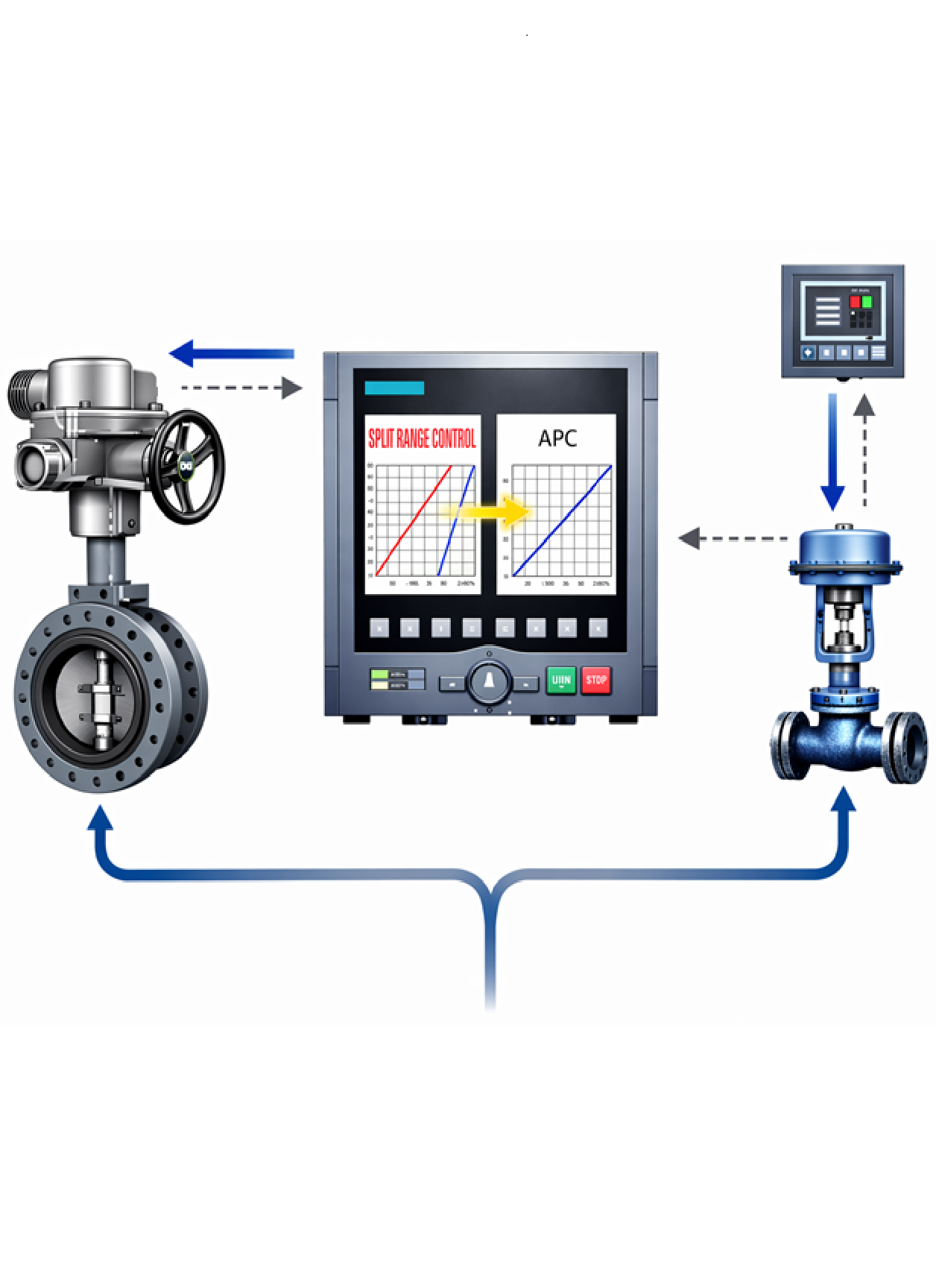
The solution combines two precisely matched control valves into a highly dynamic, sensitive unit.
This not only eliminates dead zones and hysteresis but also opens up control ranges that conventional designs can no longer structurally cover.
APC is particularly suitable for turbocompressors, blow-off lines, and safety-critical processes where stability and repeatability are top priorities.
The solution is robust, suitable for industrial plants, and can be integrated into existing systems – without interfering with the machine's basic design.
As of October 28, 2025, the innovative control valve solution was registered as US Patent 12,454,959 B2. A corresponding EP application is pending. A German utility model is in force.


Relevant knowledge – explained concisely.
Our FAQs provide initial guidance. If you want to delve deeper, contact us – the real solutions emerge through dialogue.
APC combines two functionally different valves:
- a small, precise control valve for stable operation in the partial load range
- a large control valve for high volume flows and rapid relief
Both valves are not separately, but coordinated and overlappingly controlled.
The control system continuously decides which valve handles which portion.
Result:
stable control over the entire operating range – without switching points or instabilities.
Ein einzelnes Ventil muss gleichzeitig:
- kleine Durchflüsse präzise regeln
- große Durchflüsse schnell und sicher abführen
Das führt zwangsläufig zu Zielkonflikten:
- großes Ventil → schlechte Regelbarkeit im Teillastbereich
- kleines Ventil → zu geringe Kapazität im Störfall
Diese physikalische Grenze lässt sich konstruktiv nicht auflösen – nur umgehen.
APC:
- avoids the "one valve for all" compromise
- operates without abrupt switching points as with Split Range
- enables continuous, stable control
- reduces operation of large valves in the unfavorable partial load range
In practice, this means:
- better control quality
- less oscillation
- lower mechanical load
Yes, in most cases.
Prerequisites:
- Sufficient space for a second valve
- Adjustment of the control strategy
- Integration into existing control system
The modification remains manageable, as the core function (Blow-Off / Anti-Surge) remains unchanged.
APC reduces:
- Continuous operation of large valves in the inefficient partial load range
- Unnecessary actuating movements
- High actuating forces for small control deviations
The large valve operates predominantly in its optimal range,
the small one handles the fine-tuning.
Result:
Less wear, longer maintenance intervals.
Split Range means:
- defined switchover point between two valves
- only one valve active at a time
APC means:
- both valves operate simultaneously
- no switchover points
- continuous distribution of the control variable
This eliminates the typical weakness of Split Range:
instability in the transition range.
Because there is no critical transition.
With Split Range:
- minor error at the switchover point → system jump
- often leads to oscillation or control deviation
With APC:
- smooth transition
- continuous adjustment of both valves
The system remains stable even under changing conditions.
Anti-Surge verlangt gleichzeitig:
- höchste Präzision nahe der Pumpgrenze
- maximale Durchflusskapazität im Notfall
Genau hier versagen klassische Einzelventile.
APC trennt diese Aufgaben:
- kleines Ventil → präzise Regelung nahe Surge
- großes Ventil → schnelle Entlastung
Damit wird erstmals beides gleichzeitig zuverlässig erfüllt.
APC reduces:
- unnecessary blow-off
- operation in inefficient valve positions
- pressure losses due to oversizing
Savings depend heavily on operation, but:
typically measurable effects result from more stable operation and fewer control losses.
APC enhances safety through:
- reliable relief via the large valve
- stable control without oscillation
- reduced likelihood of erroneous actuations
Important:
The safety function (e.g., emergency blow-off) is fully maintained.
Commissioning involves three steps:
- Basic parameterization of the valves
- Tuning the control split (small/large)
- Fine-tuning in actual operation
The focus is on:
- stable transition
- reproducible behavior
- practical settings, not laboratory values
Competitors typically use:
- Single valves
- Boosters
- Split-range logic
APC takes a different approach:
- Functional separation of tasks
- Adaptive, overlapping control
- Seamless control strategy without switching points
The difference is not necessarily in the valve itself,
but in the control concept.
Downloads
You can download product information here. Please feel free to contact us for any further inquiries!